What Is the Best Smart Coffee Grinder in 2026?
Choosing the best Smart Coffee Grinder in 2026 means looking beyond app features and polished product photos. The National Coffee Association’s 2024 National Coffee Data Trends report found that 67% of U.S. adults had coffee the previous day, the highest share in its survey history. That broad demand makes convenience relevant, but it does not prove that a connected grinder produces better coffee. Not automatically.
A useful comparison starts with the cup—and the counter. Does the grinder offer repeatable settings for espresso and pour-over? Can it dose consistently, limit grounds left behind, and clean without a brush battle? Scheduled grinding may save a rushed morning, while an app is only useful if it works reliably. Small details matter: static on the grounds bin, a clear adjustment dial, and whether the machine remembers your settings.
The U.S. Department of Agriculture’s Foreign Agricultural Service publishes Coffee: World Markets and Trade, a report tracking global production, trade, and consumption. It helps explain coffee’s scale, not the performance of any particular grinder. For that, this guide compares manufacturer specifications with practical considerations such as grind range, burr design, noise, maintenance, and software support. Features change, and marketing claims can outpace everyday usefulness. A smart grinder can still disappoint. The best choice depends on your brewing method, budget, and willingness to maintain another connected appliance. There is no perfect model for every kitchen.
What Makes a Coffee Grinder “Smart” in 2026?
What Is the Best Smart Coffee Grinder in 2026?
What Makes a Coffee Grinder “Smart” in 2026?
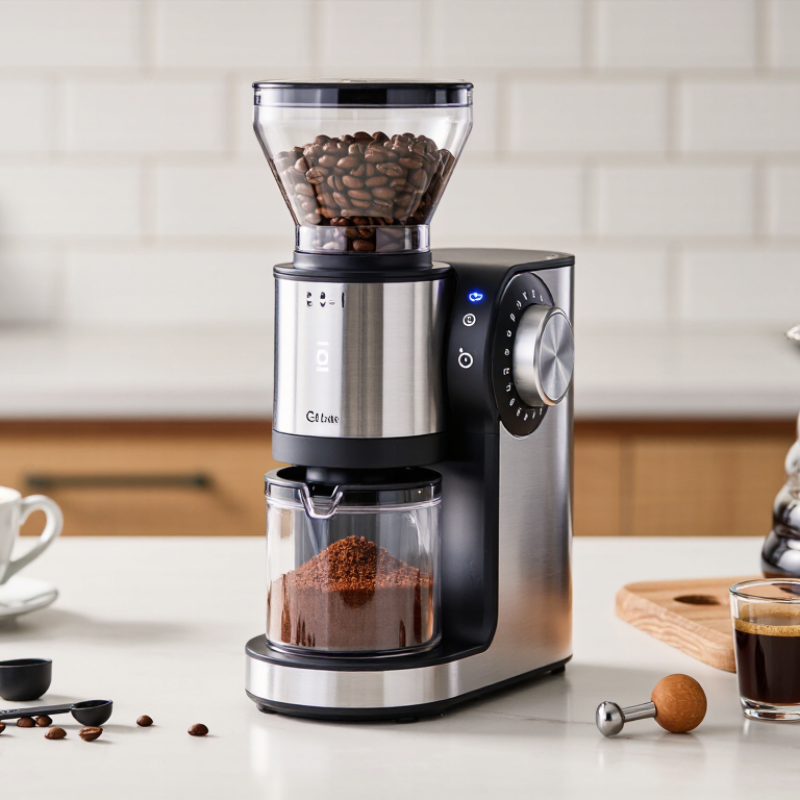
A smart coffee grinder does more than connect to an app. It may save grind settings, guide adjustments, or link a dose to a brewing recipe. The useful part is consistency: a saved setting can make tomorrow’s pour-over easier to repeat. Look for clear controls, precise adjustment steps, and settings that are simple to edit. A screen full of numbers is not automatically helpful.
Smart features should support good grinding, not distract from it. Burr alignment, grind range, and dose accuracy still matter. So does cleanup: coffee dust around the chute can affect later doses. Some grinders track usage or offer maintenance reminders, but those estimates may not reflect your beans or routine. The word “smart” can be slippery. An app may lose connection, and a saved recipe may need adjustment when beans age. That is normal, not a failure. Treat digital guidance as a starting point, then taste the cup.
Tips: Save one setting for each brew method, and change only one variable at a time. Weigh a few doses to check consistency. If the coffee tastes sour or thin, try a finer grind; if it tastes harsh, try coarser. Keep notes. They do not need to be perfect.
What Is the Best Smart Coffee Grinder in 2026? – What Makes a Coffee Grinder “Smart” in 2026?
| Smart-grinder dimension |
What it means in practice |
What to check when comparing |
| Connected controls |
A companion app or wireless connection can let users adjust settings, save recipes, or start a grind remotely. Connectivity alone does not guarantee better grinding. |
Confirm which controls work in the app, whether a connection is required for everyday use, and what happens if the service is unavailable. |
| Dose measurement |
A grinder may stop after reaching a selected dose by weight or run for a programmed time. Weight-based dosing measures coffee output; timed dosing estimates it from run time. |
Check whether a scale is built in, whether the dose is measured at the grounds container, and how the maker specifies repeatability. Results can vary with beans and settings. |
| Saved recipes |
Programmable recipes can store settings such as dose, grind duration, or grind adjustment for different brewing methods. |
Look for the number of profiles, the settings each profile actually stores, and whether adjustments can also be made directly on the grinder. |
| Grind adjustment |
A grinder still needs a mechanism to change particle size. Electronic adjustment may make settings easier to repeat, but “smart” does not automatically mean more precise or suitable for every brew method. |
Check the adjustment range, how clearly settings are marked, and whether the grinder is designed for the brewing methods you use. |
| Automation and feedback |
Some systems use sensors or programmed controls to manage a grind cycle. Features vary, and an app or preset does not by itself show that a grinder senses extraction or automatically corrects grind size. |
Distinguish automatic stopping from genuine sensor-based adjustment, and look for a clear explanation of what is measured and changed. |
| Cleaning and maintenance |
Digital reminders can help users follow a cleaning schedule, but they do not replace removing retained coffee or maintaining the burrs as directed. |
Check how the burr chamber is accessed, what routine care is recommended, and whether reminders can be reset or disabled. |
| Software support and privacy |
Connected features may depend on an app, account, wireless network, or software support. A grinder’s core controls may remain usable without these services, depending on its design. |
Review app availability, required permissions, update policy, and offline operation before choosing a connected model. |
| How to judge “best” |
There is no single best smart grinder for every user. Prioritize consistent dosing, suitable grind adjustment, easy cleaning, dependable manual controls, and useful connected features for your brewing routine. “Smart” is a feature description, not a universal performance standard. |
How to Evaluate Grind Quality, Consistency, and Ease of Use
A smart grinder should earn its extra features through better coffee, not just a polished app. Examine the grounds after grinding: are they mostly similar in size, or mixed with visible dust and larger fragments? Uneven particles can extract at different rates and make a cup taste muddled. Try the same setting and dose several times. If the results vary, the grinder’s claimed precision may not match your routine. A quick first impression can mislead; compare actual brews, not only a display reading.
Tips: Weigh the beans before each test. Keep the brew method and water amount constant. Note clumping, static, noise, and cleanup time.
Ease of use matters every morning. Check whether settings are simple to adjust, saved profiles are easy to find, and the hopper is practical to fill. Smart controls are useful when they shorten a real task, such as repeating a grind dose. They are less helpful if setup requires repeated phone pairing or menus. Small details matter. Look for removable parts that clean without awkward tools, and a clear way to make adjustments if the connection fails. A little mess is normal; persistent grounds around the counter are worth noticing.
What Is the Best Smart Coffee Grinder in 2026?
Suggested weighting for evaluating grind quality, consistency, and ease of use. These percentages are a comparison framework, not laboratory results for specific grinders.
How to use this chart: Compare grinders using the same tests. Give the greatest weight to grind consistency, then assess particle-size control, ease of use, retention, and grinding speed.
Which Smart Features Matter for Different Brewing Methods?
For espresso, prioritize fine, repeatable adjustments over app gimmicks. A tiny grind change can alter shot time and taste, so useful features include saved settings, clear adjustment steps, and weight-based dosing. A scale connection can help reproduce a dose, but it cannot correct stale beans or poor puck preparation. Small details matter.
For pour-over, look for recipe storage and easy grind-step adjustments. A grinder that remembers settings for different brewers saves guesswork when switching from a flat-bottom dripper to a cone. The Specialty Coffee Association’s Brewing Control Chart places balanced brewed coffee around 18–22% extraction yield and 1.15–1.35% total dissolved solids. Those figures are useful reference points, not a promise that an app can make every cup taste right. For French press, consistent coarse grounds and low static are more practical than shot timers.
Smart features should match the brewing routine. If you make espresso each morning, dose tracking and repeatable settings may earn their place. If you brew one large pour-over, a simple timer may be enough. Still, automation is not taste. I’d question any grinder that hides basic controls behind an app, especially when a quick adjustment at the dial is easier.
How to Compare Leading Smart Coffee Grinder Models
What Is the Best Smart Coffee Grinder in 2026?
How to Compare Leading Smart Coffee Grinder Models
A useful comparison starts with the coffee you actually brew. Espresso needs fine, repeatable adjustments, while French press calls for a coarser, even grind. Check how easily each grinder changes settings and whether it returns reliably to a saved recipe. Small details matter. A clear display, stable dosing, and a hopper that is easy to remove can make busy mornings less fiddly. “Smart” features vary, so look beyond app control: does the machine remember grind settings, guide calibration, or connect smoothly with your brewing routine?
Compare grind consistency, adjustment range, cleaning, and noise in practical terms. A grinder can offer many settings yet still make tiny changes difficult to repeat. Check whether its instructions explain calibration and cleaning, and whether parts that collect grounds are accessible without awkward tools. If possible, test it with the coffee and brew method you use most. One caveat: published specifications do not always reveal how a grinder behaves after months of daily use.
Tips: Save a setting, then brew the same coffee twice. Note the dose, brew time, and taste. A simple log helps separate useful automation from extra steps. Consider counter space, too; smart features are less appealing when setup feels like a chore.
How to Choose a Grinder for Your Budget and Coffee Habits
Your best smart grinder is the one that matches how you brew, not the one with the longest feature list.
The National Coffee Association’s 2024 National Coffee Data Trends report found that 67% of U.S. adults had coffee the previous day.
For daily drip coffee, a repeatable timer and simple settings may matter more than app control. Short on counter space? A compact burr grinder with a clear adjustment ring may be easier to live with than another screen. For espresso, prioritize fine adjustments and low grind retention; small changes can noticeably affect shot time.
The Specialty Coffee Association’s brewing guidance puts brewed-coffee extraction near 18–22%, a starting range—not a guarantee of good flavor. Choose a grinder that repeats settings, then adjust one variable at a time.
A slow, harsh-tasting brew may benefit from a coarser grind, though dose and water can also be responsible. Smart scales, dose memory, and timers help only when they suit your routine. If you make one morning pot, remote scheduling may not justify the extra cost.
Compare burr consistency, cleaning access, warranty, and replacement-part availability. A polished app can still hide a fussy workflow.