Leave Your Message
-
Phone
-
E-mail
-
Whatsapp
-
Whatsapp

China has become an important sourcing option for buyers comparing espresso equipment across price ranges. Yet “best” depends on the café, expected workload, and service available after delivery. A compact grinder for a small coffee bar may not suit a busy roastery or hotel breakfast station. Buyers should compare burr size and material, adjustment range, motor performance, dosing options, and expected daily use. These details matter. A polished product page can show specifications, but it cannot prove consistent grind quality or reliable support.
For a practical evaluation, request current technical documents, warranty terms, spare-parts information, and clear answers about customization and production timelines. Test a sample with the coffee and basket sizes you actually use. Check whether the grind remains even during repeated shots, whether adjustments feel precise, and whether cleaning is straightforward. Ask about voltage, plug configuration, packaging, and freight protection before placing a larger order. Requirements vary by destination, so confirm product documentation and import expectations with qualified local professionals. A factory visit or independent inspection may also help verify production and quality-control processes. No checklist removes every surprise. Even careful sourcing can leave unanswered questions, especially when support is distant or product revisions are poorly documented. This guide explores how global buyers can assess a China-made Espresso Grinder with evidence, realistic expectations, and attention to the details that matter after the first delivery.
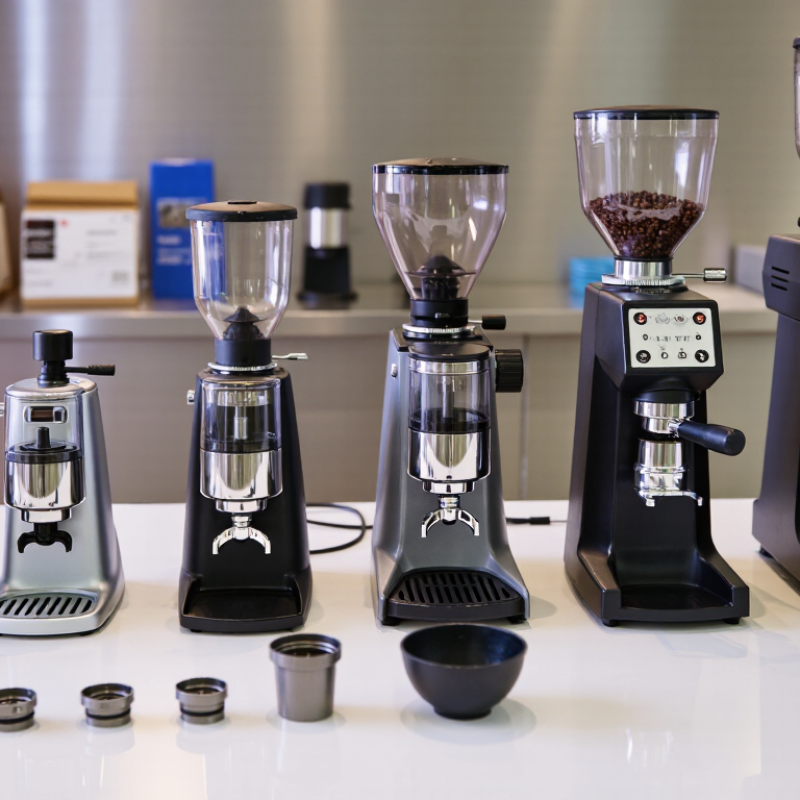
An espresso grinder reduces roasted coffee beans into particles fine enough for a pressurized extraction. Most espresso models use two burrs rather than a spinning blade. One burr turns while the other stays fixed, or both rotate in some designs. Beans pass through the gap and are ground as the burrs meet them. Adjusting that gap changes the particle size. A smaller gap usually produces finer grounds. Small changes matter.
Fine, even grounds help water flow through a compact coffee puck at a steady rate. If the grind is too coarse, a shot may run quickly and taste thin. If it is too fine, water may move slowly, though dose and puck preparation also affect the result. The grinder does not make every shot perfect. It gives the barista a controllable starting point. In daily use, fresh grounds may cling to the chute or form small clumps, so brushing and careful dosing can improve consistency. A little mess is normal. Grinder settings can also shift with bean age, humidity, and roast level, which makes occasional adjustment part of the process.
| China Best Espresso Grinder for Global Buyers? - What Is an Espresso Grinder and How Does It Work? | |||
|---|---|---|---|
| Dimension | How It Works or What It Means | Practical Data or Comparison | What Buyers Should Consider |
| Core function | An espresso grinder breaks roasted coffee beans into small, relatively uniform particles so water can flow through the coffee puck during extraction. | The motor turns a set of burrs; beans are drawn between them, ground, and discharged through an outlet. | Look for consistent particle distribution and dependable adjustment, not simply a high motor-power figure. |
| Burr design | Burrs grind coffee by cutting and shearing it between two shaped surfaces. Burr geometry and alignment affect particle distribution and workflow. | Flat burrs use two opposing flat rings. Conical burrs use a cone-shaped inner burr and a matching outer burr. | Neither design is universally best; compare grind consistency, cleaning access, replacement parts, and the intended volume of use. |
| Burr material | Burrs are commonly made from hardened steel or ceramic. Material is one factor in wear, cost, and operating characteristics. | Steel burrs are widely used. Ceramic burrs are also used in some grinders and are hard but can be more brittle if struck by a hard object. | Check burr availability, replacement cost, and the supplier's stated service life rather than relying on material alone. |
| Burr diameter | Diameter describes the size of the burr set; it can influence grinding speed and the grinder's overall design. | Espresso-capable burr sets are sold in a range of diameters. A larger diameter does not by itself guarantee better espresso. | Compare measured output, heat management, consistency, and the machine's expected daily workload. |
| Grind adjustment | Moving the burrs closer generally produces a finer grind; moving them farther apart produces a coarser grind. | Stepped grinders use fixed positions. Stepless grinders allow continuous adjustment, often with a locking mechanism. | Fine adjustment is useful because small grind changes can noticeably affect espresso flow. Confirm the adjustment is stable and repeatable. |
| Dose and workflow | A grinder may dispense by timed or weight-based dosing, or grind a weighed dose directly from a hopper or single-dose container. | Timed dosing depends on grind rate, so the delivered mass can vary. A grind-by-weight system measures dose mass; single dosing weighs beans before grinding. | Choose a workflow that fits service speed, staff routines, and how often coffee varieties are changed. |
| Ground-coffee retention | Retention is coffee left inside the grinder after grinding. It can affect freshness and cause the next dose to differ from the beans just added. | Retention varies by grinder design, dose size, grind setting, and cleaning routine; there is no single value that applies to every model. | Ask for a clearly defined retention test, including the dose size and measurement method. Consider whether the grinder is easy to purge and clean. |
| Espresso starting recipe | The grinder controls particle size; the espresso machine supplies heated water and pressure to extract soluble compounds from the coffee. | A common starting point is a 1:2 brew ratio, such as 18 g of ground coffee to about 36 g of espresso, in roughly 25–30 seconds. | This is a starting reference, not a universal rule. Adjust grind, dose, and yield to suit the coffee, basket, machine, and taste. |
| Motor and speed | The motor drives the burrs. Speed, torque, cooling, and duty rating affect how the grinder handles repeated use. | Motor speed and power are not directly comparable across designs; manufacturers may use different burrs, gearing, and test conditions. | For commercial use, verify the rated duty cycle, thermal behavior, electrical requirements, and expected grinding volume. |
| Cleaning and upkeep | Oil and fine coffee particles build up around burrs and the discharge path. Cleaning helps maintain performance and reduce stale residue. | Cleaning intervals depend on usage and coffee type. Burrs also wear over time and may need replacement. | Check whether burr access is straightforward and whether cleaning instructions, spare parts, and technical support are available in the destination market. |
| Global buyer checks | Product suitability includes more than grinding performance; shipping, electrical compatibility, documentation, and after-sales support matter too. | Confirm the rated voltage and frequency, plug requirements, applicable safety documentation, warranty terms, spare-part availability, and delivery lead time. | Request a sample grind test and written specifications. Compare like-for-like tests using the same coffee, dose, grind setting, and measurement method. |
| Selection summary | An espresso grinder is a precision tool for controlling coffee particle size and dose as part of an espresso setup. | The best choice depends on the required volume, dosing style, adjustment needs, maintenance plan, and total cost of ownership. | Evaluate grinder and espresso machine compatibility together, then validate the choice with a practical extraction test. |